The day when the Bismarck battleship sank
27-05-1941
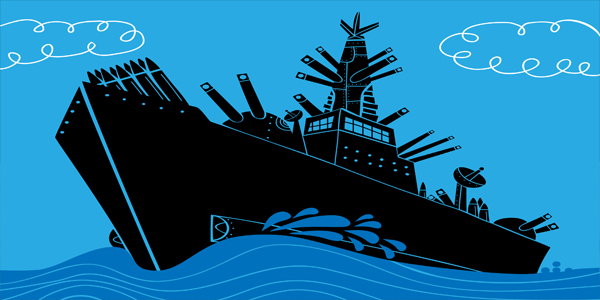
Bismarck was one of the two largest battleships ever built by Germany. It was laid down in Hamburg in 1939 with Adolf Hitler making the christening speech.
Bismarck’s task was to break into the Atlantic Ocean along with the heavy cruiser Prinz Eugen in May 1941. The two ships were supposed to raid shipping from North America to Great Britain. However, the ships were detected off Scandinavia and British ships were deployed to block their route. The battle cruiser Hood was ordered, along with other bombers, to attack the Germans.
Fire opened early in the morning of May 24, 1941, and both German ships concentrated their fire on Hood. One of the shells reached Hood’s rear ammunition magazine and a massive explosion broke the back of the ship. Hood disappeared underwater, taking all but three of its crew of 1,419 men with it.
The British prime minister Winston Churchill ordered all warships in the area to join the pursuit of Bismarck. Eventually, the ship was struck by two torpedoes and suffered serious damage. On May 27, 1941, the ship commander allowed the crew to abandon and scuttle the ship. Bismarck slowly flooded and it disappeared beneath the surface at 10:40.
Difficult words: ammunition magazine (a place where shells or other explosive material are stored), pursuit (following something), torpedo (a missile that is fired from a ship or dropped into the water from a plane and it explodes when it reaches its target), scuttle (to sink by making holes through the bottom).
How did the British response after the German ships were detected off Scandinavia lead to both the catastrophic sinking of the battle cruiser Hood and the eventual scuttling of Bismarck?
Learn 3,000 words with Days in Levels
Days in Levels is designed to teach you 3,000 words in English. Please follow the instructions below.
How to improve your English with Days in Levels
-
Test
- Do the vocabulary test at Test Languages.
- Choose your level: Level 1 if you know up to 1,000 words, Level 2 if you know 1,000–2,000 words and Level 3 if you know 2,000–3,000 words.
-
Reading
- Read one or two articles at Days in Levels every day.
- Read one older article too and check if you still remember all the new words.
-
Listening
- Play the audio and read the text at the same time. The sentence you hear is highlighted.
- Then listen to the article again without reading the text.
-
Writing
- Answer the question under the article. Write your answer in full sentences in your notebook.
-
Speaking
- Find a partner to speak English with at Speak in Levels.
- Talk about the article or use the questions from Speak in Levels.